I remember accompanying my parents to Joggers Park for their morning walks as a teen. While my parents focused on getting their morning constitutional, I preferred day dreaming by the waves. Or people watching and imagining the lives of the motley crowd that usually turned up. Among the regulars was a large group of 40 something women that would take multiple rounds of the park together, discussing everything under the sun from recalcitrant husbands, toxic workplaces, to hairstyling hacks.
Occasionally, one of them would break free from the flock and make a valiant attempt at jogging instead of walking.
“So-and-so’s wedding is coming up” I heard one such woman say once. “I need to lose weight!”
Remember the heyday of Cardio Queens and Calorie Counting?
It was a sentiment I was pretty familiar with. In college, girls my age would often turn to strict dieting or endless cardio when they needed to ‘lose weight’ for an important event. Back then, being fit meant being thin, and if you wanted to get there the roadmap was clear: cardio and dieting.
When I started going to the gym myself, in my 20s, I automatically veered towards the cardio section as well: treadmill, elliptical, crosstrainer, stationary bike. And so did all the other women in the gym with me. Nobody bothered to tell us that we could lift some weights too. The weights section was clearly demarcated for the guys.
Enter Strength Training: The Rising Star
In fact, for someone who’s always loved working out, I remained blissfully oblivious to the benefits of strength training until much later. It was only when I was nearly in my mid 30s that an instructor at the gym I went to asked me about my workout schedule. “You’re doing a lot of cardio,” he remarked casually. “What about weights?”
“Oh this is enough for me, thanks.” I informed him smugly. “I’m also doing three days of Zumba every week!”
“Great” he smirked, his tone implying completely otherwise. “But it’s not going to help you see any change in muscle tone or definition. Unless you start doing some strength training too.”
And that’s when it occurred to me that maybe my strategy of cardio, cardio and then an extra side of cardio, possibly needed a rethink. Thankfully, the gym instructor turned out to be a really good trainer, if you could overlook the permanent smirk and his undisguised disdain for Zumba (which I still love!), and I finally got started with strength training thanks to him.
And while he was right about the visible toning and definition that comes with strength training, I also discovered its various other advantages. Because as it turns out strength training comes with a whole host of hard-to-ignore benefits. But before we get to that, let’s take a quick look at what’s happening to all of us women in the middle, aka women in their 40s and above, often dealing with perimenopause in all its glory.
Why exactly is the whole world and its aunt going on about strength training?
Around the age of 40, our hormones such as estrogen and progesterone begin to fluctuate. And because these hormones influence everything from metabolism, fat storage, and muscle repair to sleep, mood, and energy levels, we can see a direct imapct on our bodies. Studies show that menopause-related hormonal changes can affect body composition and physical performance significantly.
This is often why we can see changes like annoying belly fat that suddenly piles on and stays forever like an unwanted plus one, lower energy levels, and reduced muscle mass. Which is why our 40s often call for a smarter balance between cardio and strength training, coupled with nutrition and recovery strategies.
And this is where those benefits of strength training for women over 40 become relevant.
The (many, many!) benefits of strength training
Here’s a quick look at all the good stuff strength training does:
Combats muscle loss (aka sarcopenia)
Women begin losing muscle naturally after the age of 30, and this process accelerates when we hit our 40s. Research shows that as women age, they naturally lose muscle mass over time, making strength preservation critical. Strength training helps rebuild and preserve lean muscle mass.
Improves bone density
Weight-bearing exercises stimulate bone growth, which is crucial for reducing the risk of fractures and osteoporosis, particularly during and after menopause.
Boosts metabolism
Muscle tissue is more metabolically active than fat. So when we build muscle, we elevate the body’s resting metabolic rate, making it easier to manage weight and avoid midlife weight gain.
Supports joint health
When our muscles get stronger, they provide better support to the joints that they surround. This significantly reduces the risk of daily aches and pains, strains, and arthritis symptoms.
Enhances metabolic health
Strength training improves insulin sensitivity, lowering the risk of type 2 diabetes, heart disease, and high blood pressure.
Boosts brain and mental health!
Research indicates that strength training improves memory, and mood, by releasing beneficial chemicals (myokines) and mood-boosting endorphins.
What’s the deal with cardio when you’re in your 40s?
If you’re someone who loves cardio (Zumba lovers unite!), you don’t have to give it up completely. In fact cardio is great for heart health, lung function, and circulation. You just need to ensure that you have a good balance between cardio, strength training and some form of flexibility or functional mobility work, and are not doing an excess of cardio.
What happens when you do too much cardio?
Excessive cardio can increase cortisol, which is our body’s primary stress hormone. And when cortisol remains elevated for long periods that’s what can lead to stubborn belly fat, cravings, feeling constantly tired, and seeing fewer results despite working out.
So, does this mean you need to hit the gym, stat?
If the thought of gym memberships and heavy barbells is making your head spin, relax. The best form of strength training is often the one you’ll actually do consistently. And going to a gym is not the only way to get started with strength training. You can always start with basic movements that use your own body weight such as squats, lunges, hip hinges, wall sits, modified push ups etc.
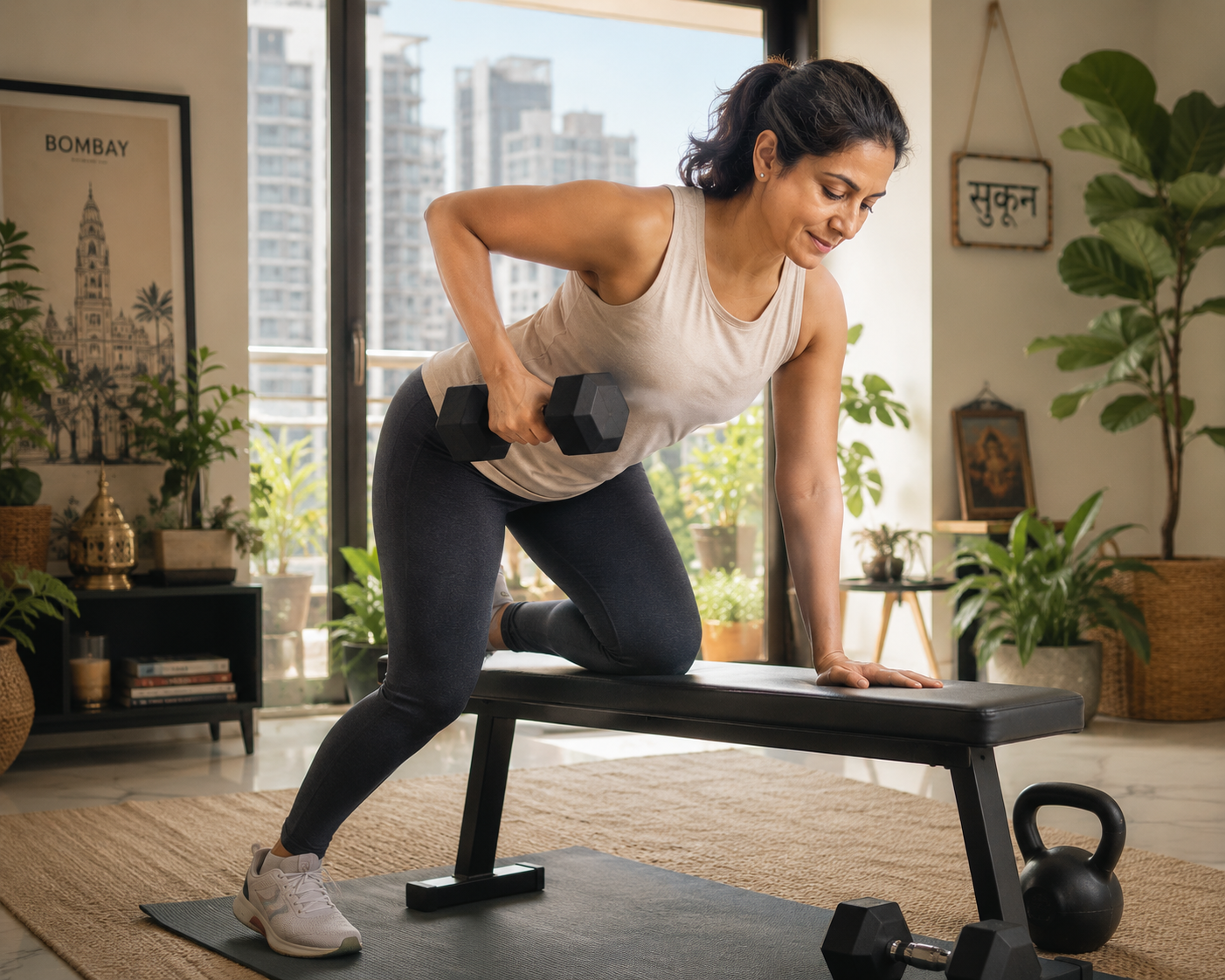
Once you get comfortable, you can add in light dumbbells and resistance bands. One tip, based on my own experience: invest some time and effort in finding a good trainer. It is well worth the investment if you’re a complete novice because it will ensure that you get your form right while strength training and minimize the risk of injury. Once you’re comfortable, you can always continue on your own. Start slow and build up steadily, working towards incorporating strenght training at least twice a week into your fitness routine.
And while I’m in granny mode and dispensing advice, please focus on your recovery, nutrition, and sleep when you begin your strength training journey. They are all equally important components of the fitness process, especially in our 40s and above.
Oh, and don’t worry about looking like the Hulk either!
This is a common apprehension many women have when they first begin their weight training journey.
Will lifting weights make me look bulky and more muscular than I’d like?
The truth is, building significant muscle mass requires years of dedicated training and specific nutrition strategies. So you’re not going to start looking like a bodybuilder. You will notice some very different benefits though, such as improved strength, better posture, greater confidence, enhanced energy levels, and better body composition.
Strong is the new skinny!
The good news is that with all the increasing awareness around the benefits of strength training for women, the gym scene has changed quite dramatically. From yoga mats and cardio, I now see women all around me lifting weights. There’s a 65 year old woman at the gym I go to who lifts a loaded barbell without batting an eyelid. Gym bros move reverentially out of her path. Other women, nimbly rack up plates, no help needed. There are now an equal number of men and women on the treadmill, both getting some cardio in, before their serious lifting.
And it’s a refreshing change to hear the gym talk among the women too. The conversations have slowly moved from getting skinnier, and looking thin, to getting stronger. Being healthy is no longer about hitting a number on the weighing scale or fitting into a dress size. It’s about having enough energy to get you through a tough day at work, and still having the ability to sort out your child’s forgotten homework assignment later in the evening, without having a meltdown of your own. Or lifting your own heavy luggage into the overhead compartment on an airplane. And, most importantly, about feeling good in your own body as you age.
Quick Questions, Wellthinest Style 🙂
How often should women over 40 do strength training?
Most health organisations recommend strength training at least two times per week, targeting all major muscle groups. If you’re new to exercise, it’s a good idea to start gradually and seek guidance if needed.
Is walking enough?
Walking is great for cardiovascular health, mood and overall wellbeing. However, walking alone does not provide the same stimulus for building and maintaining muscle as dedicated strength training.
Can I start strength training if I’ve never exercised before?
Absolutely. You can begin even in your 40s, 50s and beyond. The key is to start at an appropriate level and progress gradually.
Do I need to eat more protein if I start strength training?
Probably not dramatically more, but it is worth paying attention to. Strength training and protein work as a team: the training provides the stimulus, while protein helps your muscles recover and grow stronger. Since many Indian women already fall short on protein, strength training can be a good opportunity to take a closer look at what’s on your plate.
Am I too old to start strength training at 45 or 50?
No. Research shows that women can gain strength and muscle at virtually any age. Many women begin strength training in their 40s, 50s, and beyond. Start at a level you are comfortable with, under guidance, and progress at a pace you are comfortable with.
Will strength training make me bulky?
Not likely. Building significant muscle mass requires years of dedicated training and specific nutrition strategies. Most women who strength train notice improved strength, better posture, enhanced energy levels and a more toned appearance rather than excessive muscle bulk.
Do I need to join a gym to start strength training?
No. Strength training can be done using bodyweight exercises, resistance bands, dumbbells or weight machines. The best strength training programme is often the one you can do consistently.